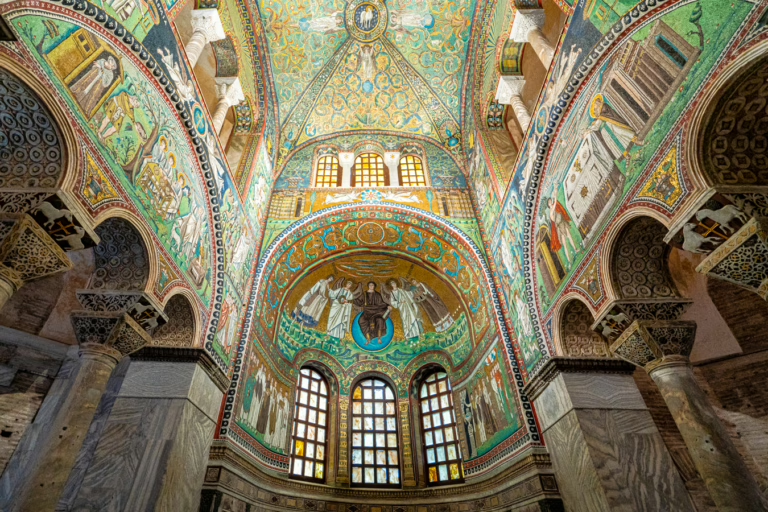
I have been dreaming of touring the jaw-dropping Ravenna mosaics for years… and even still, I managed to underestimate just how absolutely magnificent they are to admire in person.
Tucked away in the eastern part of Emilia-Romagna, Ravenna sees far fewer visitors each year than Italy travel hotspots like Rome and Florence. And yet, it’s home to some of the most significant and downright mesmerizing art in the country (which is particularly impressive, since this is Italy we’re talking about).
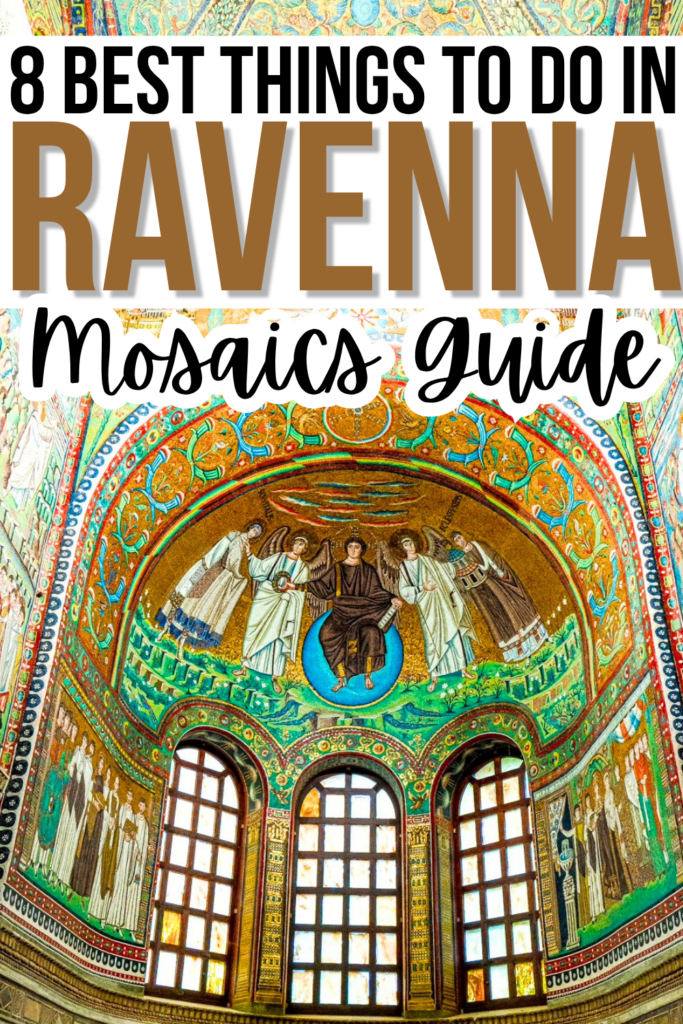
In the 5th and 6th centuries, an impressive collection of brilliant mosaics were created in Ravenna, and today, the “Early Christian Monuments of Ravenna” are recognized as a UNESCO World Heritage Site.
If you’re hoping to step a bit off the beaten path in Italy while diving deep into the country’s art, Ravenna belongs on your Italy bucket list (and it doesn’t hurt that Emilia-Romagna is home to some of the best food in Italy, either).
We visited all 8 of the buildings that make up this remarkable UNESCO World Heritage Site and walked away absolutely smitten with the roughly 1500-year-old mosaics of Ravenna, Italy.
Here’s everything you need to know about visiting the remarkable Ravenna mosaics!
Planning a Ravenna mosaics trip at the last minute?
This is a very long, detailed blog post, and we’ll cover everything from independent ticket options to itinerary ideas to places to stay (we enjoyed this hotel) here!
However, if you’re planning at the last minute and have limited time in Ravenna, here’s how to stop researching right now and have a fantastic visit: book this mosaics tour that we loved (the 3 hour/5 monument option), show up at the meeting point, and be amazed!
We can and will offer dozens of details and alterations, but that alone will allow you to have an excellent time visiting Ravenna’s mosaics, with no more planning (or any need to score competitive timed entry slots at the last minute).
- Guided Tour of the Ravenna Mosaics (5 monuments in 3 hours: we LOVED this experience!)
Why Visit the Mosaics of Ravenna, Italy (A Brief History)
Sure, we know they’re absolutely beautiful, but what’s the historic relevance of Ravenna’s unique mosaics?
Ravenna’s political history is long and varied and, like many Italian cities, it was ruled by a variety of powers over the last couple of millennia.
The Early Christian Monuments of Ravenna that we can explore today, though, primarily date to the 5th and 6th century AD.
Around 190 BCE, Ravenna was conquered by the Roman Empire, and a few centuries later, it served as the capital of the then-shrinking Western Roman Empire from 402 to 476.
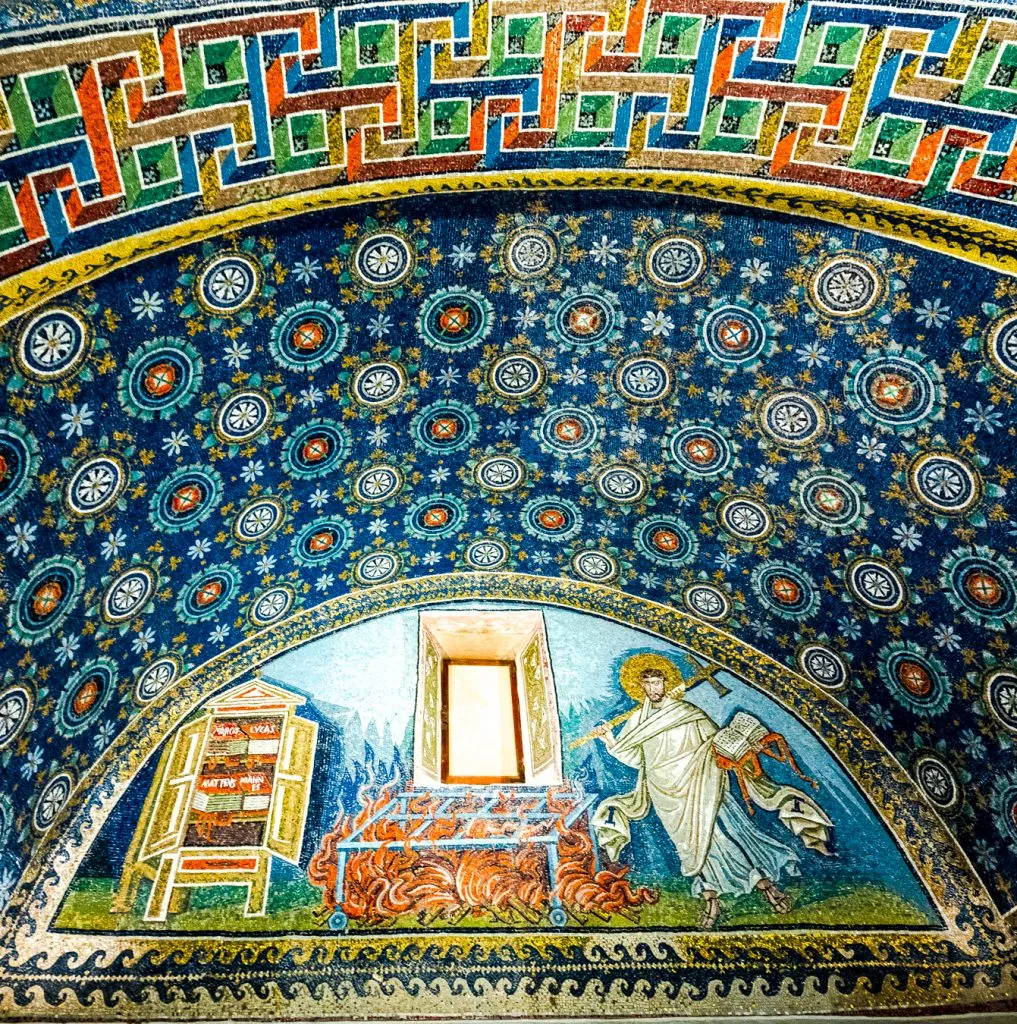
This is when the first of the masterpieces of Ravenna mosaics we see today were created, including the Mausoleum of Galla Placidia.
In 476, the Western Roman Empire fell, and the Eastern Roman Empire (or Byzantine Empire, ruled out of Constantinople) took over Ravenna.
The second batch of mosaics, including the Basilica of San Vitale, were created over roughly the next century.
Political strife surrounding religious differences continued throughout this time.
Most notably, Emperor Theodoric the Great (whose name you’ll see pop up quite a bit when visiting Ravenna) was a member of the now-obscure Arian sect, which Ravenna’s primarily Roman Catholic population was, to put it mildly, unhappy about.
Like the vast majority of pre-Renaissance European art, the artists who created the mosaics are uncredited and anonymous–but whoever they were, it’s safe to say that they created something remarkable and enduring.
Do You Need a Tour to Visit the Ravenna Mosaics?
You don’t need a tour to visit the Ravenna mosaics, but we chose to take this one (the same tour is also available on Get Your Guide) and loved the experience!
By definition, the mosaics are all about the detail, and having a guide with us to point out the context we would have missed on our own (ranging from depictions of emperors to a place where later rulers had erased their political rivals from mosaics) truly enhanced our experience.
By booking a tour, we also didn’t have to worry about making or timing reservations to visit the Mausoleum of Galla Placidia or the Neonian Baptistery, both of which require timed entry and a 2 Euro surcharge to enter.
Plus, Ravenna mosaic tours are very affordable. Ours cost less than 15 Euro more per person than visiting independently would have!
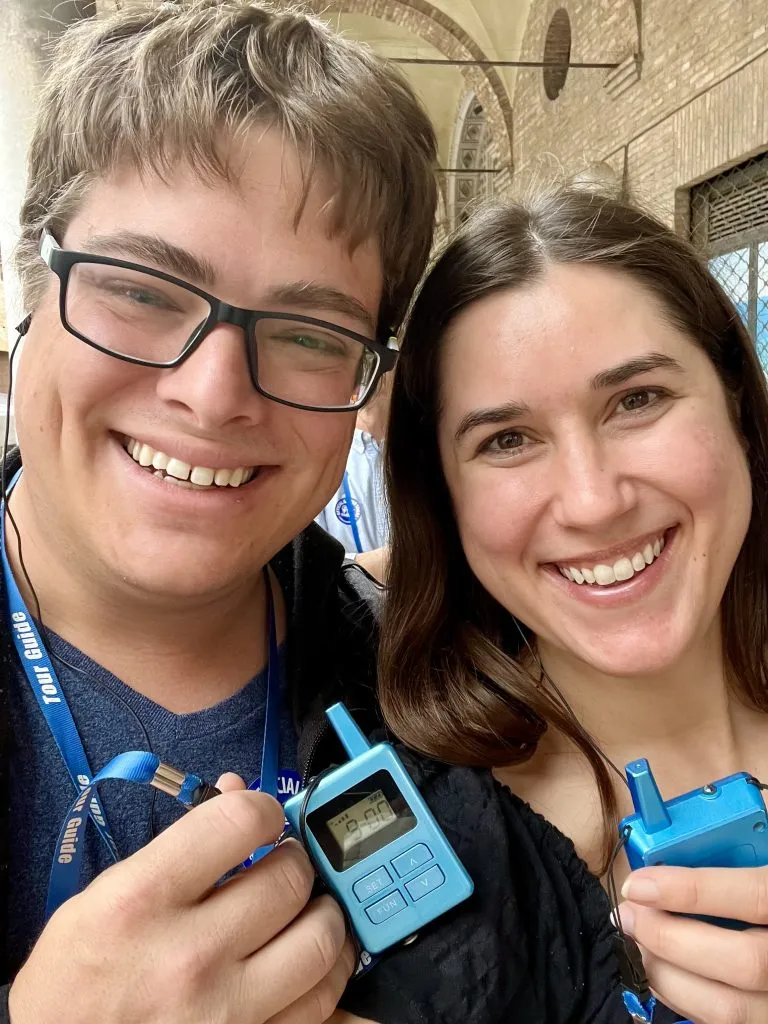
(As is usual for us, this tour was not sponsored and no one knew we were travel bloggers when visiting.)
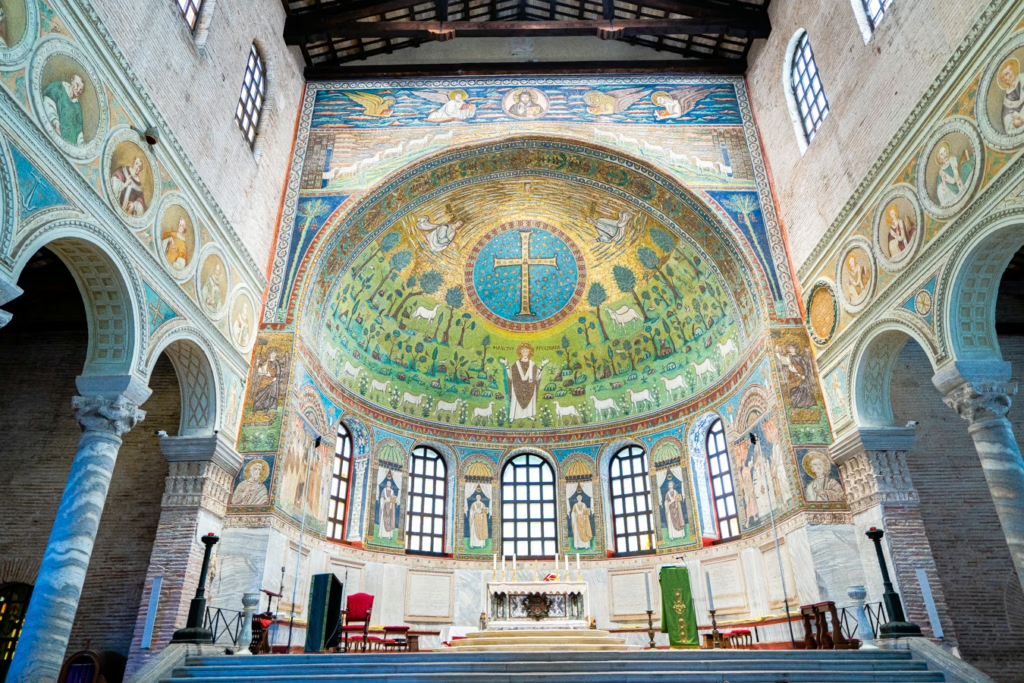
Our Ravenna tour took us to the 5 mosaics that are ticketed together (the Basilica of San Vitale, the Neonian Baptistery, St. Andrew’s Chapel and the attached museum, the Mausoleum of Galla Placidia, and the Basilica of Sant’Apollinare Nuovo).
The next day, we visited the Arian Baptistery, Mausoleum of Theodoric, and Basilica of Sant’Apollinare in Classe independently.
While we loved getting to continue our explorations beyond taking a tour, we are so glad we started with the context of a tour and felt it enhanced our experience of visiting Ravenna overall.
The 8 Locations of Ravenna’s UNESCO Mosaics
The UNESCO-recognized “Early Christian Monuments of Ravenna” are spread across 8 separate monuments, including churches, baptisteries, and mausoleums.
Of the 8 buildings, 6 are located in the historic center and can be reached on foot, while 2 of them are outside the center (I’ve marked these with an asterisk below).
I’ll (try to) keep this section brief, but when we’re talking about the mosaics of Ravenna, these are the 8 sites to keep in mind!
The Top Locations of Mosaics in Ravenna, Italy
Of the 8 locations included in Ravenna’s Early Christian Monuments UNESCO recognition, 5 of them can be visited with a combination ticket. You can choose between a 2, 4, and 5 monument ticket, but cannot purchase individual admission.
The 5 monuments ticketed together are also typically the sites included on Ravenna mosaics tours like ours, and for obvious reasons, they tend to be the most visited overall.
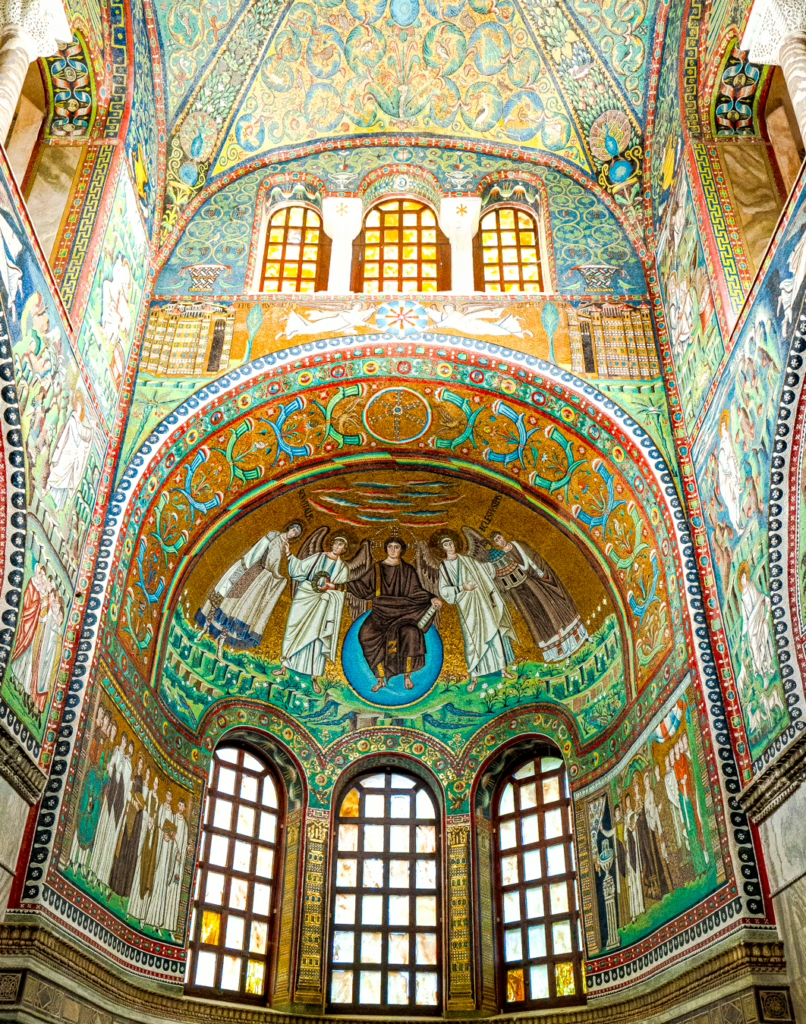
Basilica of San Vitale
If you can only visit one mosaic during your trip to Ravenna, make it this one. It alone is worth the price of the combination admission ticket!
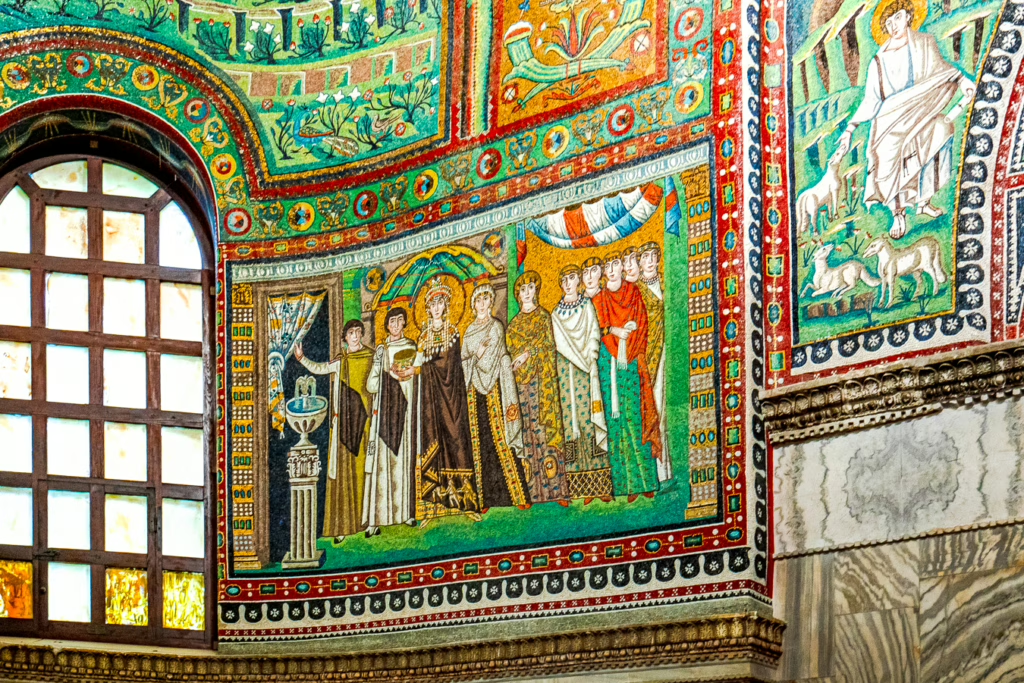
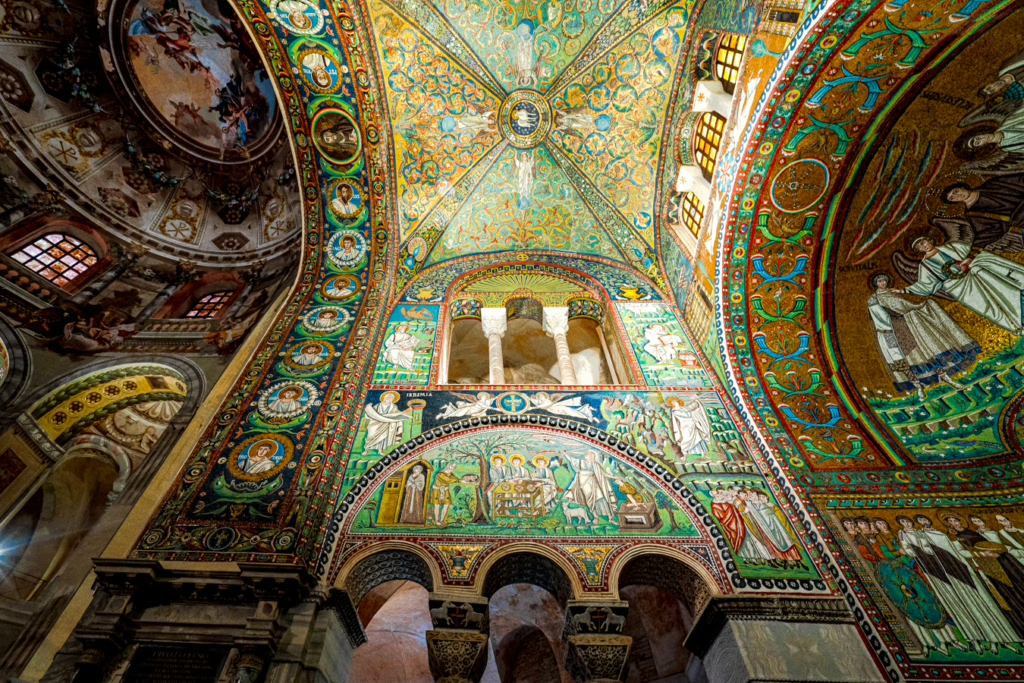
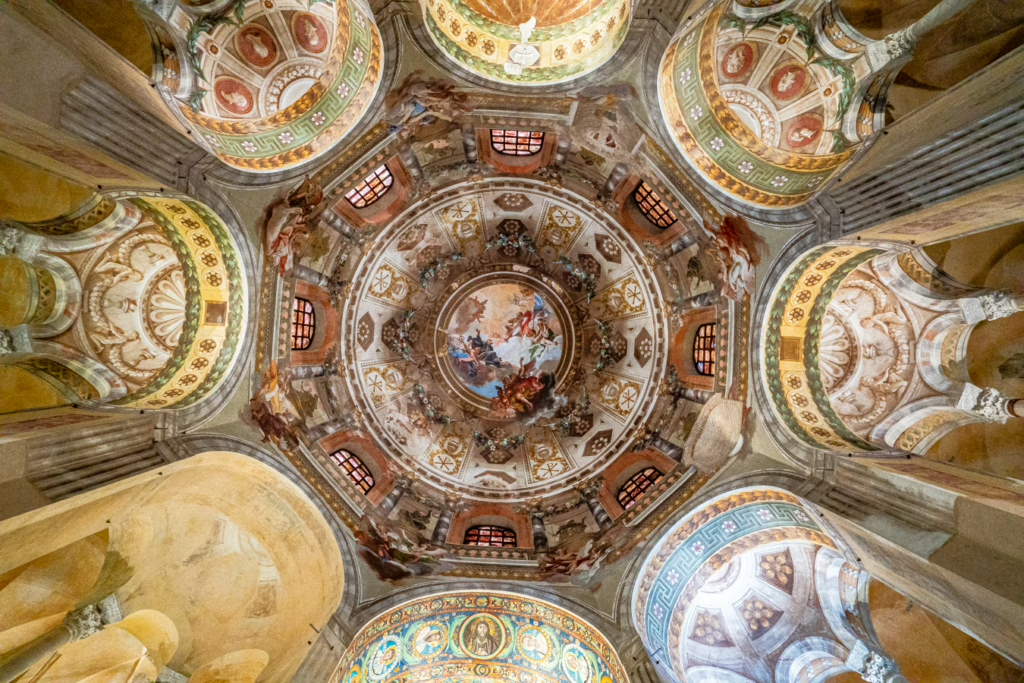
Home to an 18th-century painted dome done in the Baroque style, one of the most striking things about the Basilica of San Vitale is that details like its dome–the prize of most churches in Italy–are a mere footnote in the face of what just may be the city’s most striking mosaics.
Built in the 6th century, the Basilica of San Vitale’s mosaics are impressive for their scale, beauty, and also for boasting famous depictions of East Roman Emperor Justinian I, as well as Empress Theodora on an opposite panel.
Neonian Baptistery
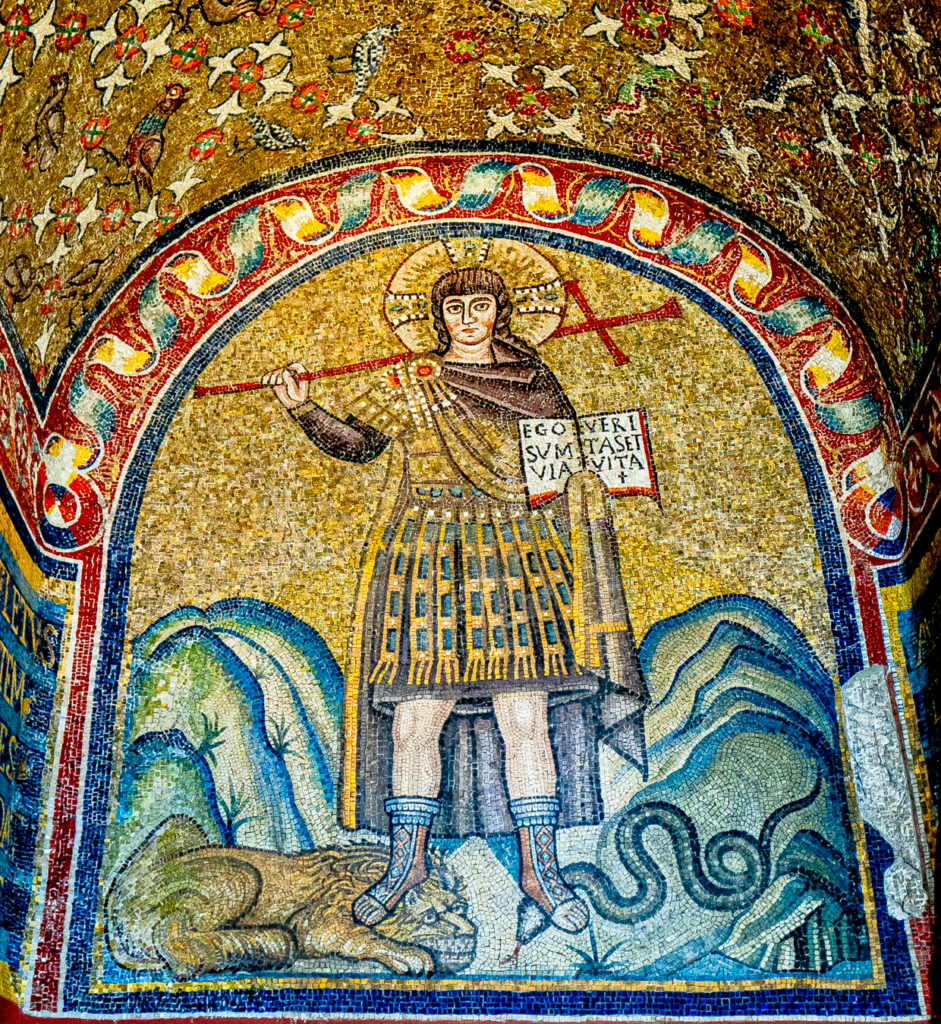
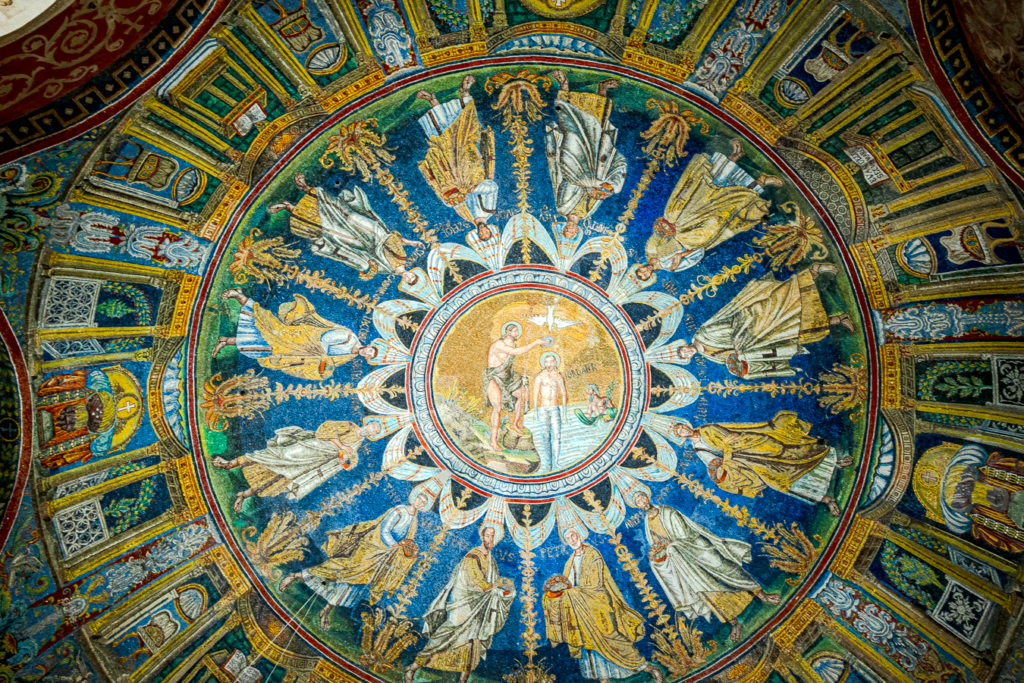
Also called the Orthodox Baptistery, the Neonian Baptistery is the oldest of the monuments making up Ravenna’s UNESCO World Heritage Site.
The baptistery, like many buildings in Ravenna, has sunk over the centuries, but the ceiling of mosaics is as brilliant as it was when completed at the end of the 5th century.
The primary mosaic depicts John the Baptist baptizing a bearded Jesus.
Basilica of Sant’Apollinare Nuovo
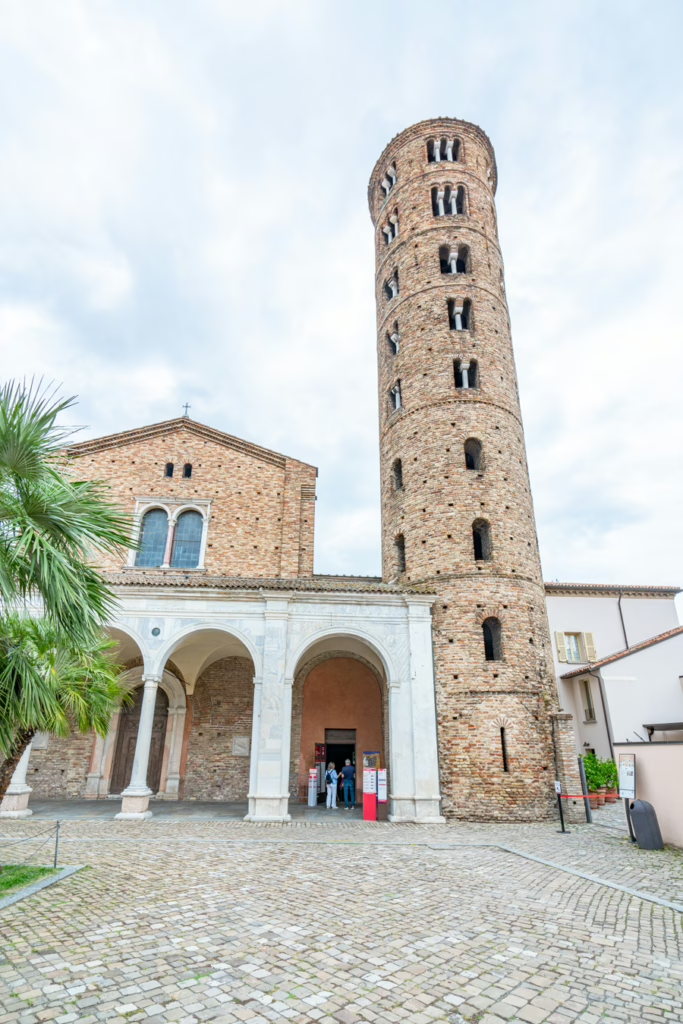
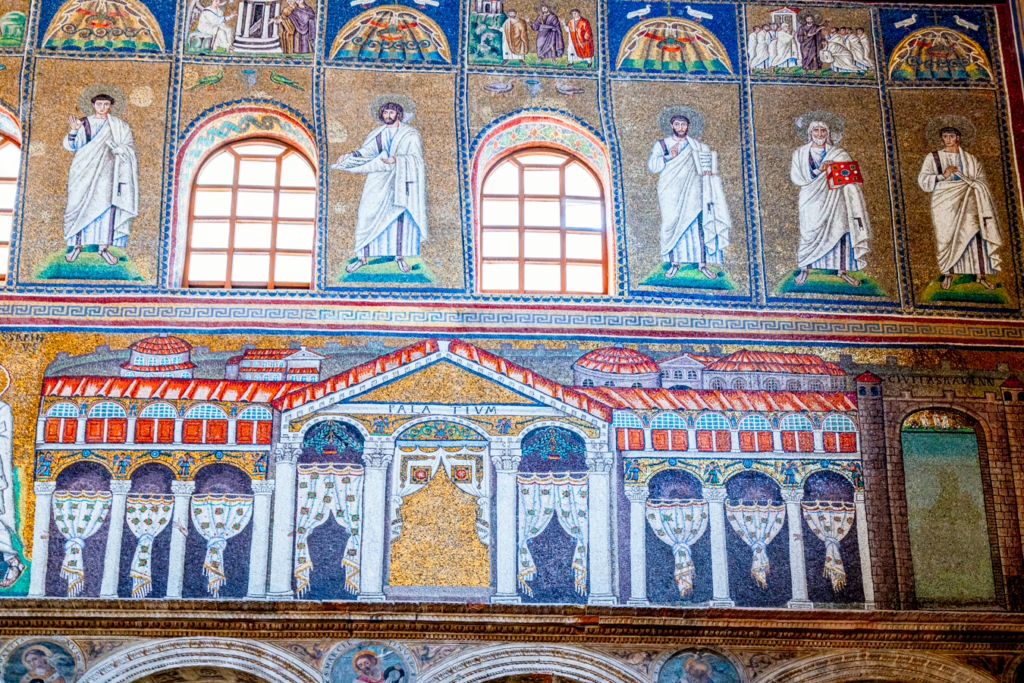
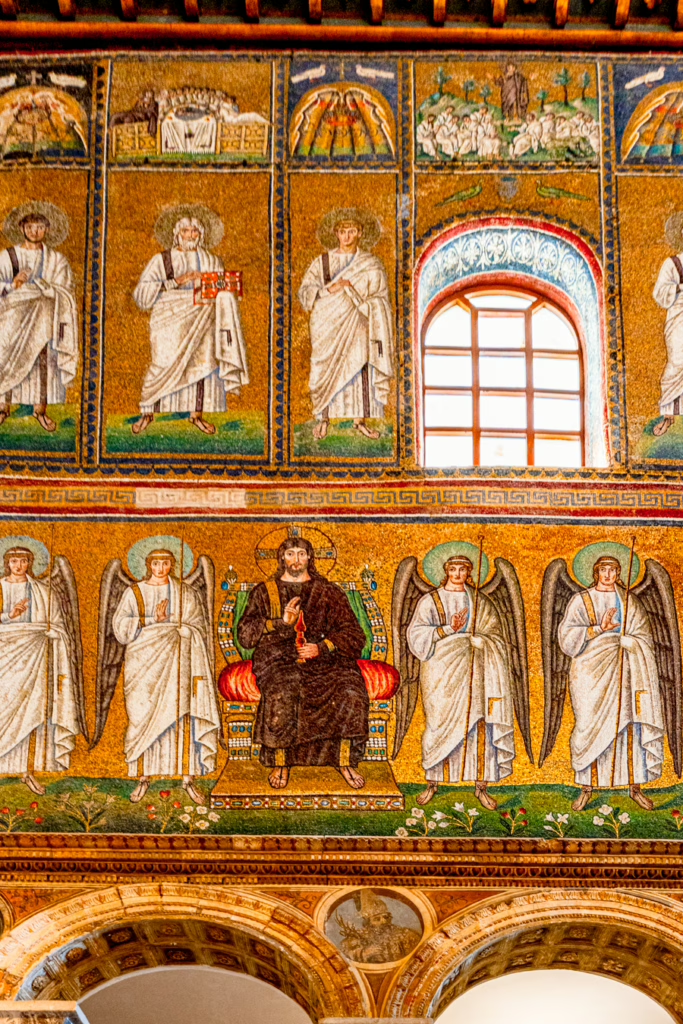
The spacious Basilica of Sant’Apollinare Nuovo started its life as an Arian church, and both the church and the mosaics have undergone many changes through the centuries.
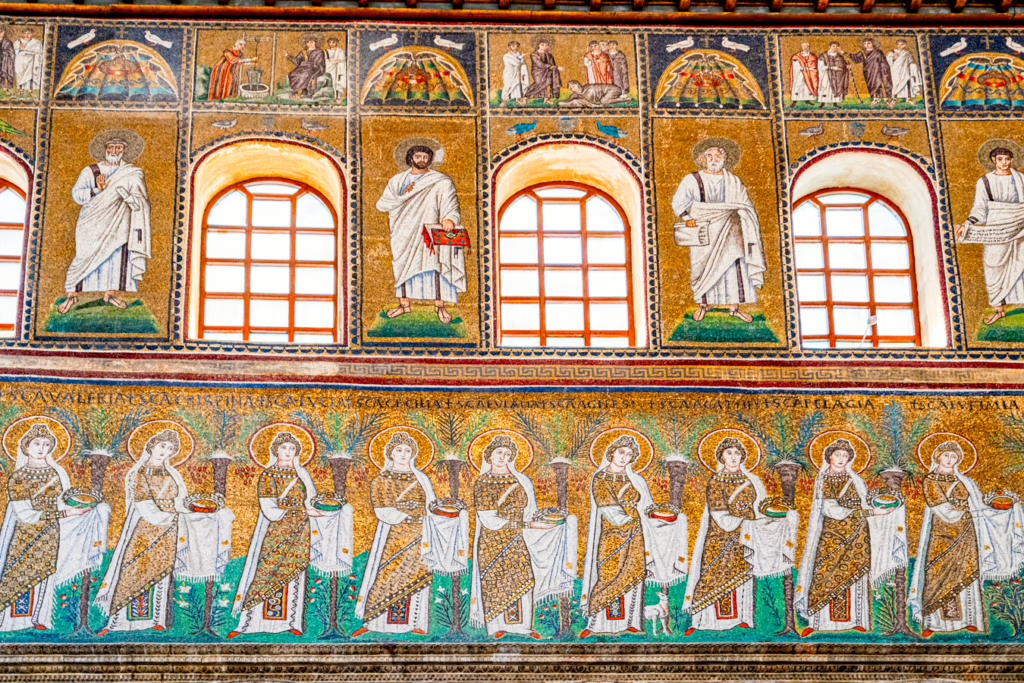
Notably, you can even see where the Byzantines later erased depictions of Theodoric and his court.
Keep an eye out for the stray hand that made it through the alterations!
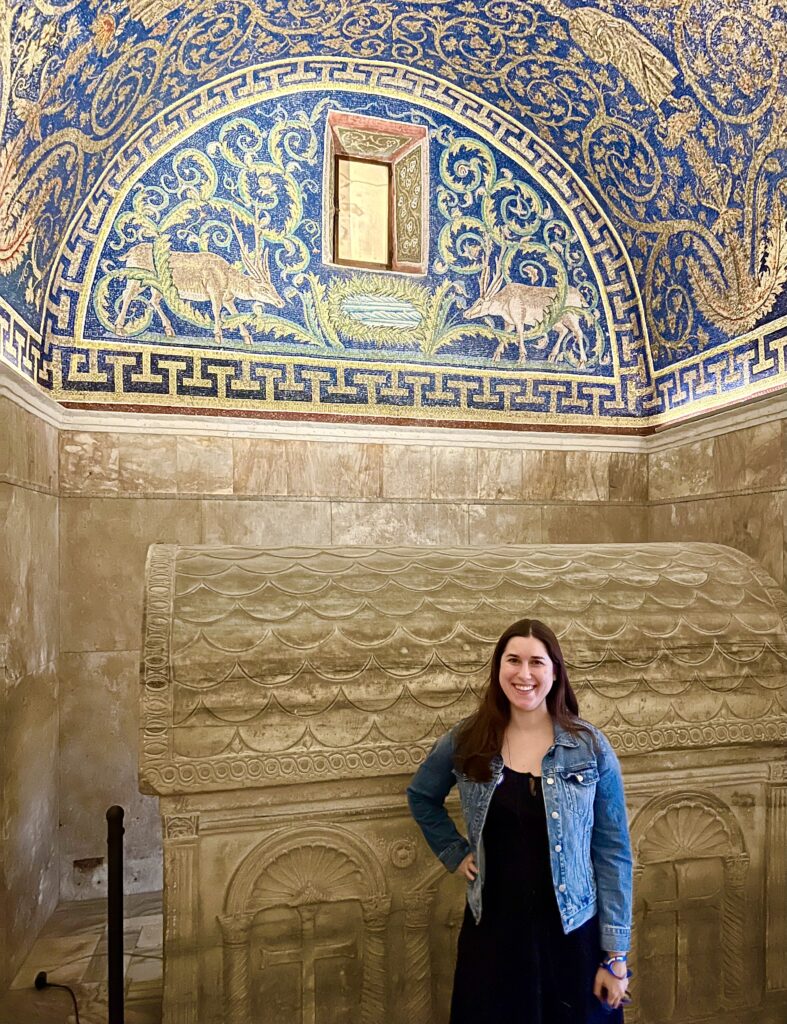
Mausoleum of Galla Placidia
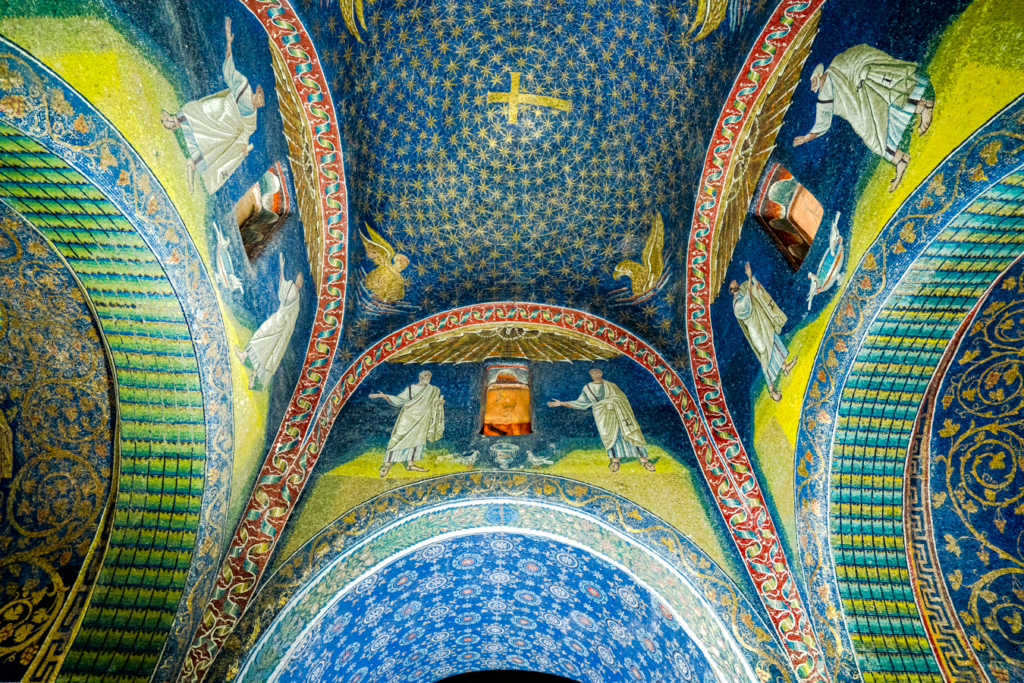
Constructed between 425 and 450, this magnificent building is one of the most memorable Ravenna monuments.
It also isn’t actually a mausoleum: that’s a centuries-old misconception.
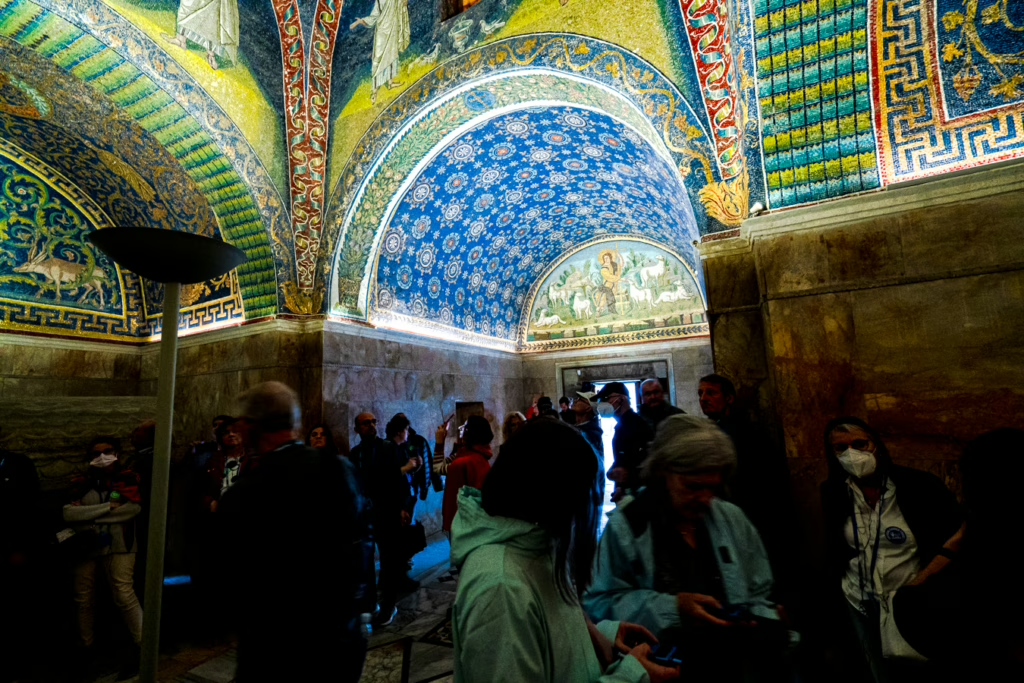
The Mausoleum of Galla Placidia, though, is simultaneously one of the smallest of the monuments and one of the most striking, as the interior of this tiny building is positively covered with intricate mosaics.
Definitely be prepared for crowds when visiting, but standing inside this small building is a mesmerizing experience!
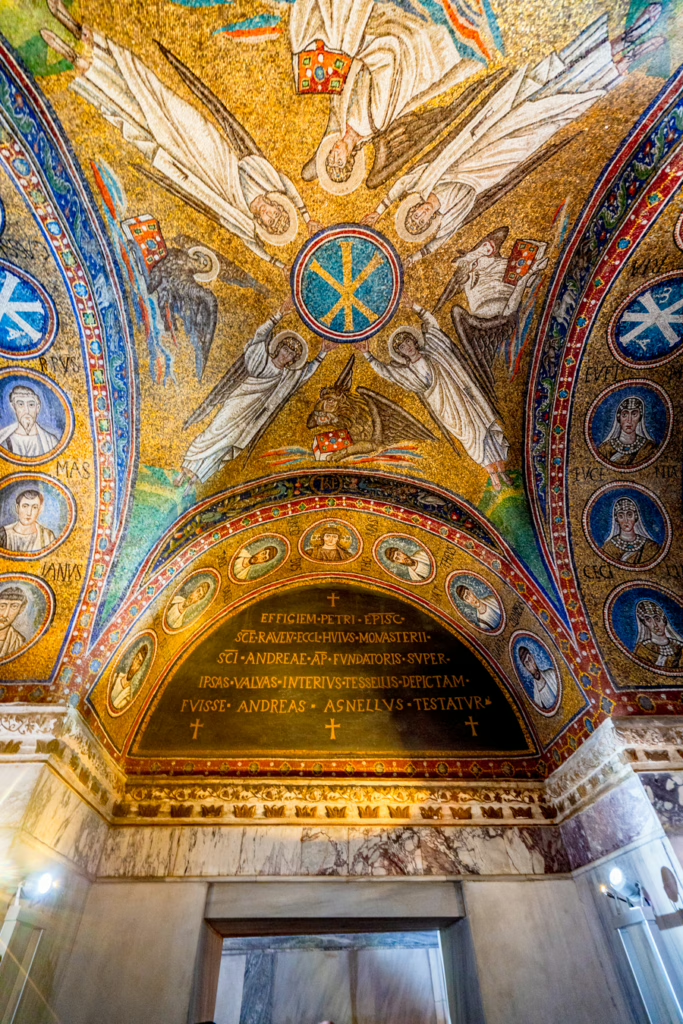
St. Andrew’s Chapel (Archepiscopal Museum)
Once the private oratory of Orthodox bishops, today, you can find St. Andrew’s Chapel (also called the Archepisocal Chapel) within the Archepiscopal Museum.
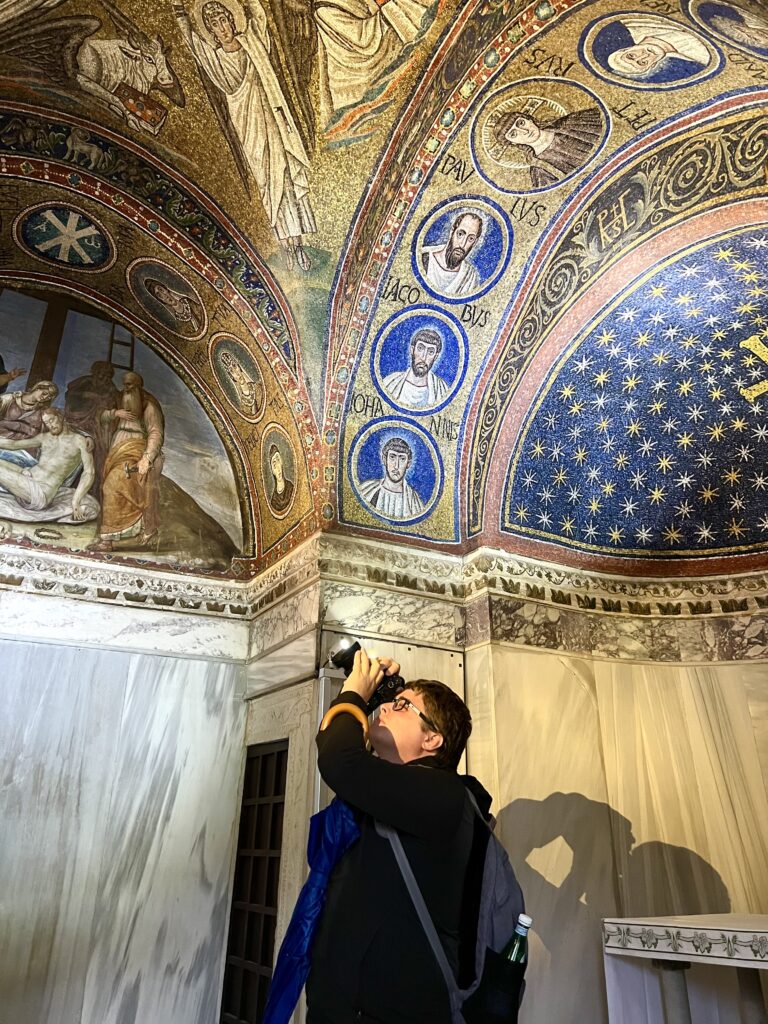
Like the Mausoleum of Galla Placidia, St. Andrew’s Chapel is memorable for the amount of detail and beauty packed into a comparatively tiny place.
If you look closely (or have a tour guide with you to point it out), there’s also a lot of anti-Arian sentiment depicted in the art.
Once you wrap up at the chapel, you can take a spin through the attached museum, as well!
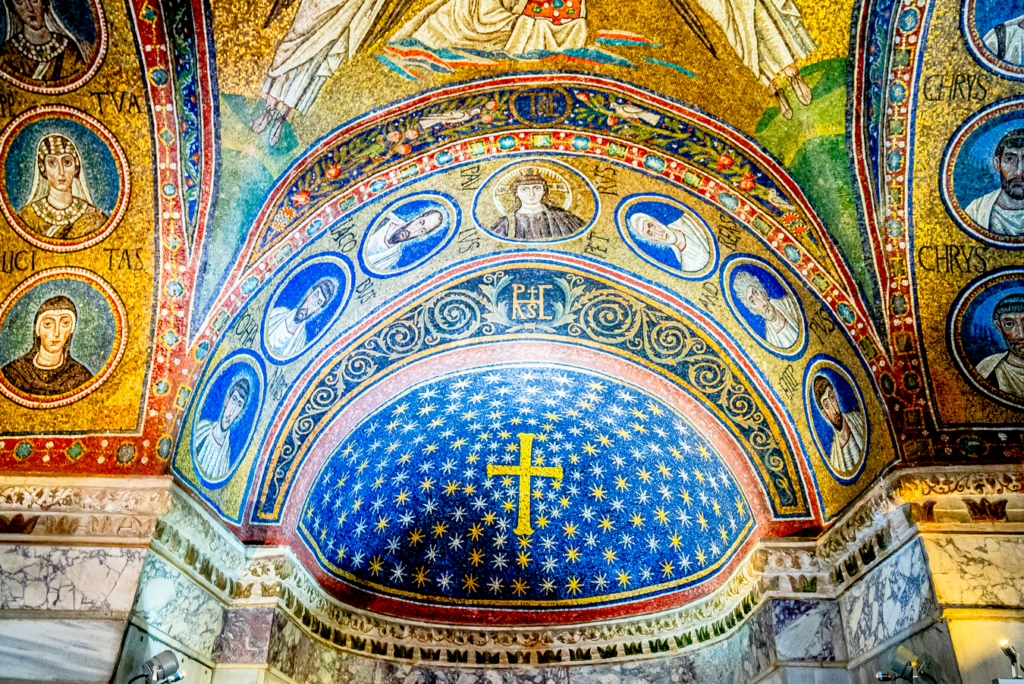
UNESCO Ravenna Mosaics That Aren’t Ticketed Together
The following 3 mosaic locations are not included in the traditional combination ticket, and 2 of the 3 of them are located outside the historic center of Ravenna.
They are, however, included in the UNESCO designation, and beautiful in their own right!
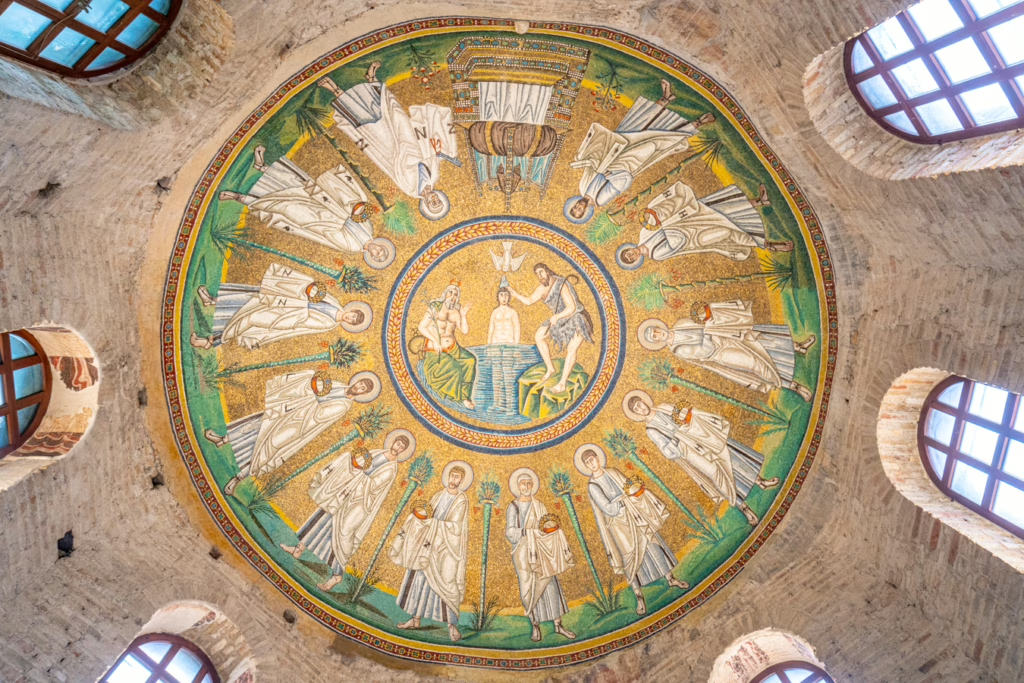
Arian Baptistery
The Arian Baptistery is much less visited than the other monuments in Ravenna’s historic center and is similar in many ways to the Neonian Baptistery.
Uncrowded and beautiful, it also depicts John the Baptist baptizing Jesus (now clean-shaven) in the Jordan River.
Built at the end of the 5th or beginning of the 6th century, this baptistery was built to serve the now-obscure Arian Christians (King Theodoric, who ruled at the time, was a member of the Arian sect).
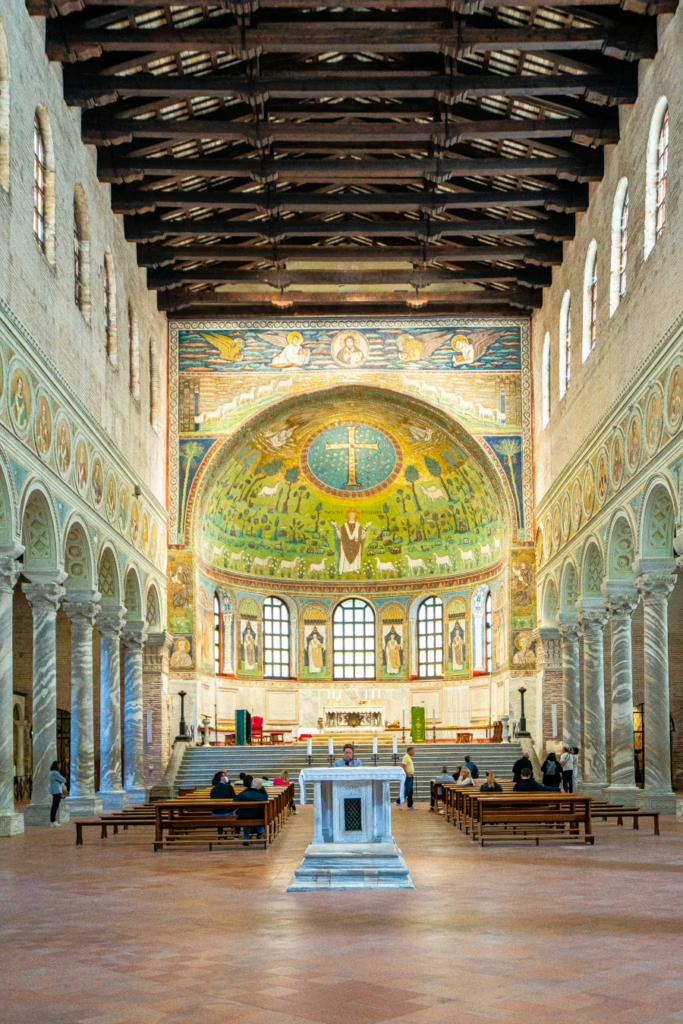
Basilica of Sant’Apollinare in Classe*
The Basilica of Sant’Apollinare in Classe is located roughly a 15-minute drive, taxi ride, bus ride, or train ride away from Ravenna, but it’s worth the effort.
Consecrated in 549 AD, this basilica is spacious and stunning, with memorable mosaics that will stick with you long after you leave.
And, thanks to its location, it tends to be much less crowded than, say, the Basilica of San Vitale.
Right across the street, you’ll find Ristorante Albergo S. Apollinare, which we can heartily recommend for a casual, delicious lunch of classic Emilia-Romagan food.
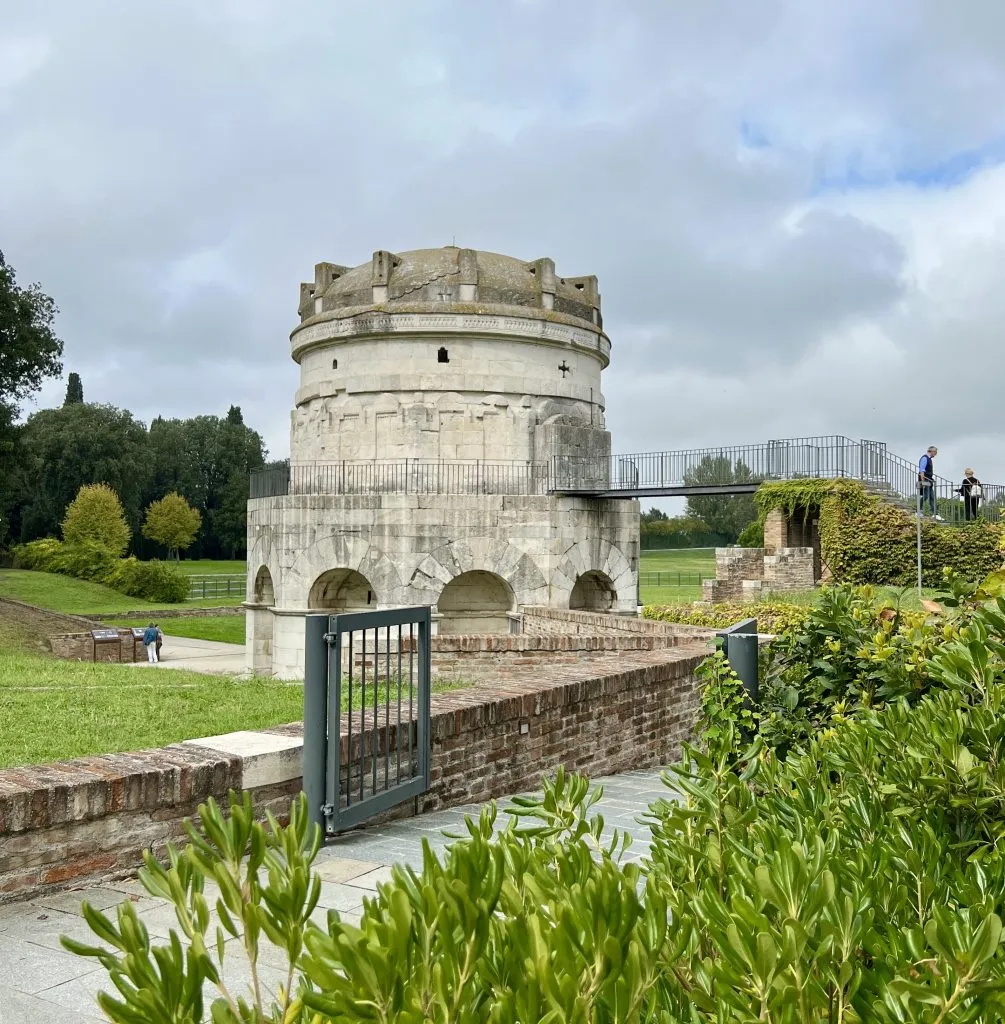
Mausoleum of Theodoric*
Dating to 520 AD, this striking mausoleum is located outside the city center of Ravenna.
It’s also the only one of the Early Christian Monuments of Ravenna that is included in the UNESCO Site but is not currently home to any mosaics.
For that reason, we wouldn’t necessarily recommend prioritizing it over any of the other monuments.
The interior as it stands today is very plain, though it was originally home to the remains of Theodoric the Great (the same ruler who had the Arian Baptistery built and who was erased from the mosaics in the Basilica of Sant’Apollinare Nuovo).
If you want to see every part of the UNESCO Site, it’s worth stopping by to at least see the exterior, but otherwise, we’d say it’s not something you need to go out of your way for.
Our #1 Tip for Visiting the Ravenna Mosaics
If we could give just one tip for visiting Ravenna’s mosaics, it’s this: move around as you observe them.
The colors, patterns, scenes, and themes can vary wildly as you move your body just a few feet in any direction, and seeing which scenes “pop” the most at a given angle is one of the most rewarding parts of seeing the mosaics in person!
Be sure to choose angles both close up and at a distance, too: the effect can be staggeringly different.
Go slow, move around, and savor the beauty around you, because it is absolutely worth savoring.
A Sample One Day Ravenna Itinerary
Only have one day in Ravenna, Italy, and want to see as many mosaics as possible?
Honestly, we think booking a tour like ours is a great way to see a good chunk of the monuments efficiently, but if you’re willing to plan ahead and move at a decent clip, you can definitely do it independently too.
If you get a very early start, head first to the Arian Baptistery for a quick look at an uncrowded attraction (if you start later in the morning, consider skipping this step).
From there, head directly over to the Basilica of San Vitale and the Mausoleum of Galla Placidia, which are located right next door to each other.
After that, drop by the Piazza del Popolo and have lunch nearby.
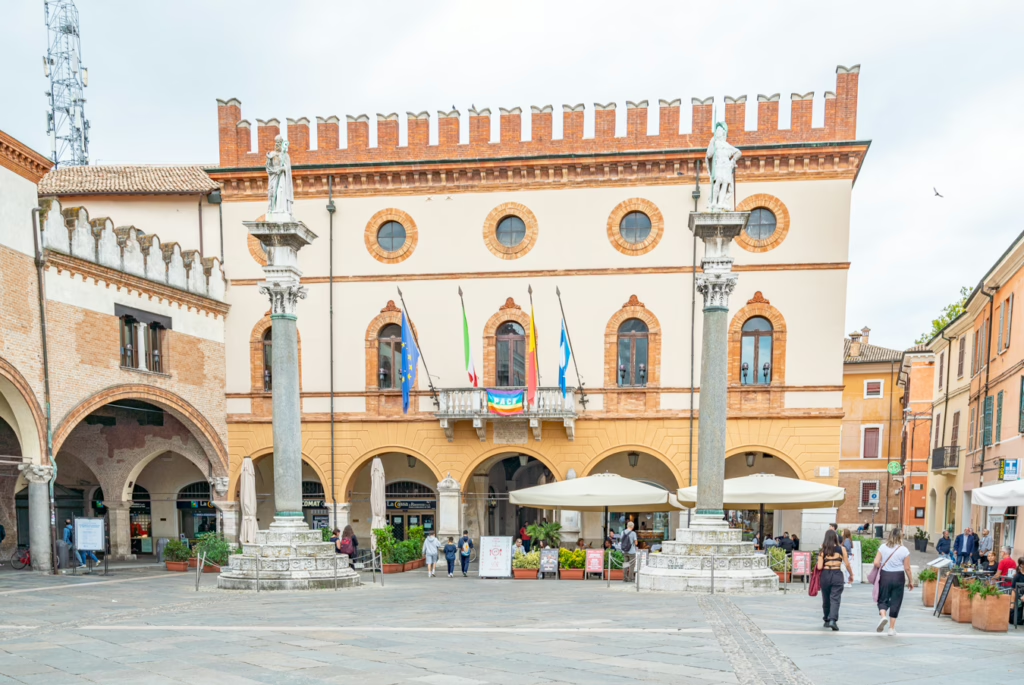
Piadina (local, delicious flatbread) sandwiches are popular for a takeaway lunch, but if you have time, consider sitting down and enjoying a delicious meal of Emilia-Romagan classics.
We had a fantastic lunch at Osteria dei Battibecchi during our trip to Ravenna and highly recommend it!
In the afternoon, pay a visit to the Neonian Baptistery, St. Andrew’s Chapel, and the attached Archiepiscoal Museum, all of which are located right by each other.
After that, you can loop around to the Basilica of Sant’Apollinare Nuovo.
This route allows you to both start and end near the Ravenna Train Station, so it is workable as a day trip.
However, this is an extremely ambitious one day Ravenna itinerary. If you’re traveling independently, don’t be afraid to trim a monument or two in order to savor the journey!
FAQ For Visiting the Ravenna Mosaics
Is a day trip long enough to see the Ravenna mosaics?
Ravenna makes a great day trip from Bologna, a good one from Florence, and a doable-but-ambitious one from Milan and Venice. But is a day long enough to experience the Ravenna mosaics?
Yes and no.
A day is long enough to see a decent chunk of the monuments, probably around 4-5 depending on how fast you sightsee, if you book a tour, and how well you plan your trip.
If you’d like to see all the mosaics, or you’d like to enjoy Ravenna beyond the monuments, spending a night or 2 would be better.
And, if you base yourself in Ravenna, you can take day trips to plenty of interesting places from the city too, starting with Ferrara and Brisighella.

Do you need to take a tour to visit the Ravenna mosaics?
You certainly don’t need to take a tour to visit the monuments, but we greatly enjoyed the tour we took!
Ravenna’s mosaics are absolutely magnificent, and they’re packed with more symbolism and detail than a first-time visitor can hope to notice on their own.
We loved the historical context that having a tour guide offered, as well as being given advice on things like certain angles to stand at in order to get the best views of the panels.
And, not having to worry about making reservations for the Mausoleum of Galla Placidia or the Neonian Baptistery was a plus, too.
How much does it cost to visit the mosaics in Ravenna?
As of 2026, the combination ticket to 5 of the Ravenna mosaics costs 14.50 Euro, and a 2-monument ticket to the Basilica of San Vitale and the Basilica of Sant’Appollinare Nuovo is 10.50 Euro.
The Chapel of St. Andrew, the Mausoleum of Galla Placidia and the Neonian Baptistery, all required a specific timed entry slot. For us, getting to avoid those logistics was a big benefit of booking a tour!
The Arian Baptistery costs 2 Euro.
The Mausoleum of Theodoric costs 4 Euro (you can see the exterior for free), and the Basilica of Sant’Apollinare in Classe costs 5 Euro.
Which Ravenna mosaics are the best to visit?
All of the Ravenna mosaics are absolutely stunning, but if you’re very short on time, we’d recommend prioritizing the Basilica of San Vitale and the Mausoleum of Galla Placidia.
Conveniently, these 2 buildings are located right next door to each other!
Do you need a reservation to visit the mosaics of Ravenna?
If you’re visiting the mosaics independently, you’ll need to make a reservation to enter the Neonian Baptistery, the Chapel of St. Andrew, and the Mausoleum of Galla Placidia.
If you’re visiting as part of a tour, your guide will take care of this for you.
The Mausoleum of Galla Placidia in particular is well worth planning around, I’d rank it among my favorite of all the monuments!
The rest of the mosaics can be visited without reservations.
Where can you buy tickets for the Ravenna mosaics?
If you would like to visit the mosaics independently, you can purchase a combination ticket for (up to) 5 of the locations here.
When you purchase your tickets, you’ll also be directed to choose a timed-entry sloth for the Neonian Baptistery, the Chapel of St. Andrew, and the Mausoleum of Galla Placidia. The slots do fill up, so we recommend planning a bit ahead if you can!
The entry tickets are valid for one entry to each monument, spread over a 7 day period.
The Arian Baptistery, Mausoleum of Theodoric, and Basilica of Sant’Apollinare in Classe are ticketed separately, and you can buy tickets for each at the corresponding locations.
Can you buy tickets for visiting the Ravenna mosaics in person?
Yes, you can purchase the combination ticket for (up to) 5 monuments at the Basilica of Sant’Apollinare Nuovo or the Archiepiscopal Museum (where St. Andrew’s Chapel is located).
However, if you have your heart set on visiting as many of the monuments as possible, it’s better to buy tickets online (and make the necessary reservations) in advance.
Other Interesting Things to do in Ravenna, Italy
While the UNESCO-recognized mosaics are by far and away Ravenna’s top attraction, you’ll find plenty of other fun things to do in the city, too!
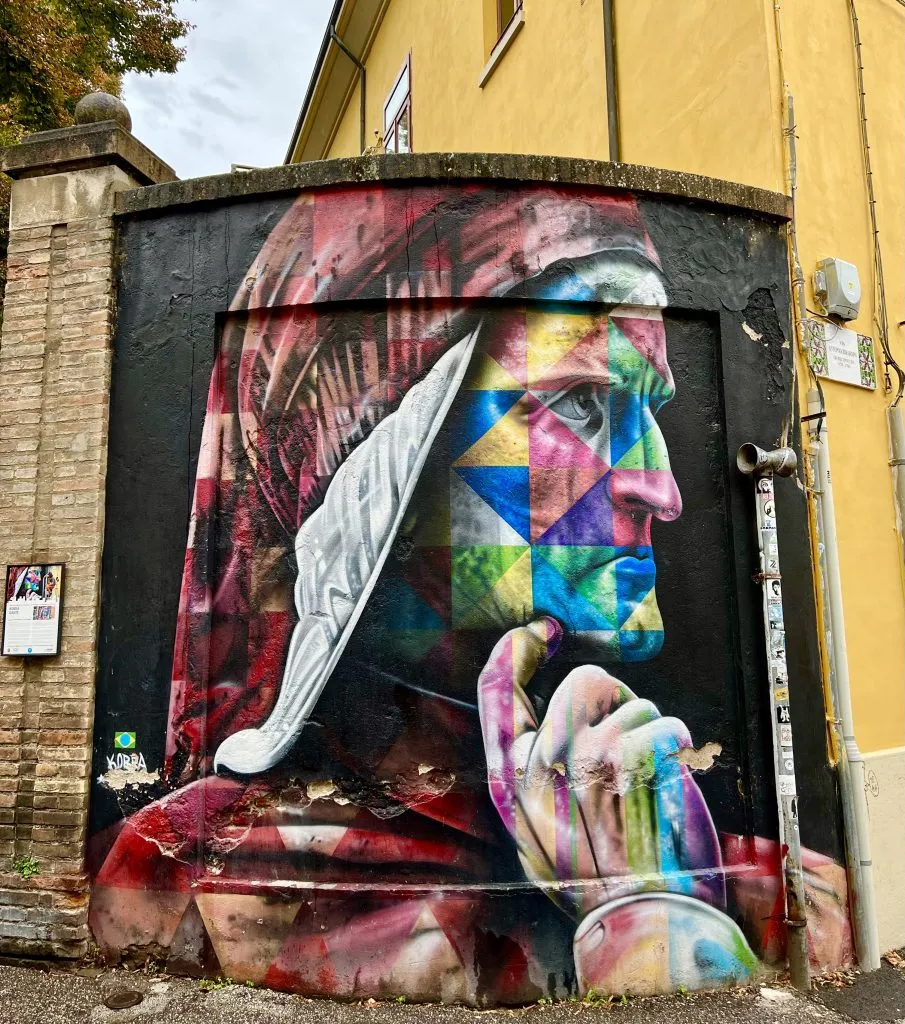
Dante Alighieri (or simply Dante) lived part of his life in Ravenna, and you can find his tomb in the city center, as well as the aptly named Dante Museum.
The city center is beautiful and worth wandering through as well. Be sure not to miss the indoor market!
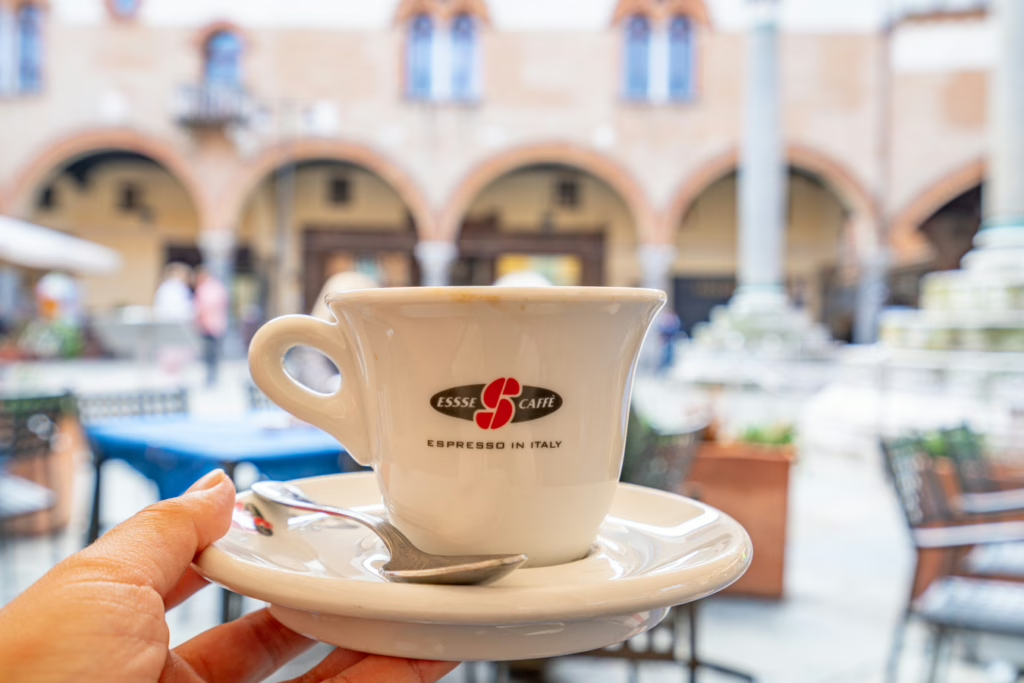
Dropping by the Piazza del Popolo for an Italian coffee break and some people-watching is also a delight when visiting Ravenna.
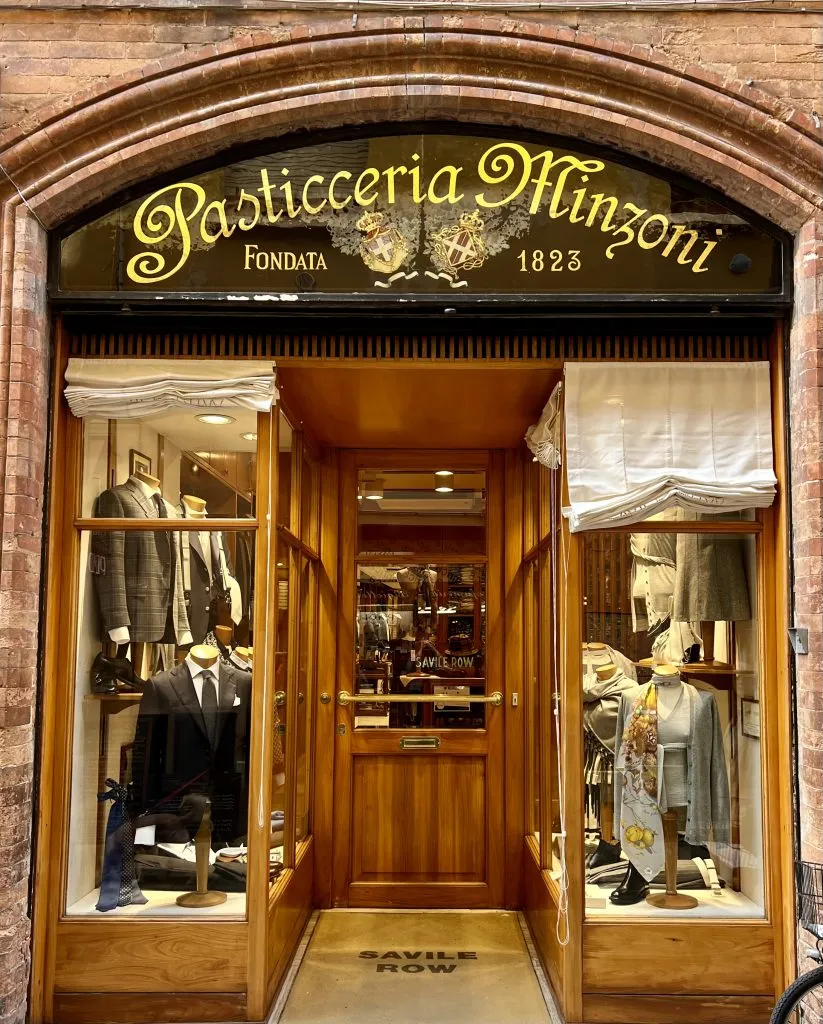
The city’s shopping street follows where its river once flowed (Ravenna, like Venice, was built on a swamp and is still slowly sinking).
Outside of the mosaics included on the UNESCO list, you can find several other examples of the art as well, including at the Basilica of San Francesco, the Domus of the Stone Carpets, and the TAMO Museum.
The National Museum of Ravenna, housed in a historic monastery, is also an interesting place to visit.
And, though Ravenna isn’t necessarily a go-to beach destination for non-Italian travelers, there are lots of Adriatic beaches nearby if you’re craving a bit of sun and sea air!
Where to Stay in Ravenna
As far as places to base yourself in northern Italy go, Ravenna is extremely affordable and has a wide variety of wonderful places to stay!
We checked into the NH Ravenna Hotel just outside the historic center and had a great stay. We love NH hotels in general, especially when traveling with our dog Ranger, and have stayed with them in several places in Europe.
For a more traditional feel in a historic building, you can’t go wrong with Santa Maria Foris or the absolutely stunning Casa Masoli.
Casa Masoli features exquisite decor and an extremely popular breakfast on top of being housed in a 17th-century building.
If you’re looking for another modern option, Palazzo Bezzi Hotel gets excellent reviews and features both a rooftop deck with views and an on-site spa.
Check rates & book your stay in Ravenna today!

How to Get to Ravenna, Italy
Ravenna is well-connected by rail, and for most visitors, traveling to Ravenna by train will be the easiest way to get in and out of the city.
The train station is located within a short walk of the historic center.
If you’re visiting Ravenna as part of a longer Emilia-Romagna road trip like we were, there is also ample affordable parking outside the center (some of the least expensive we saw on this road trip).
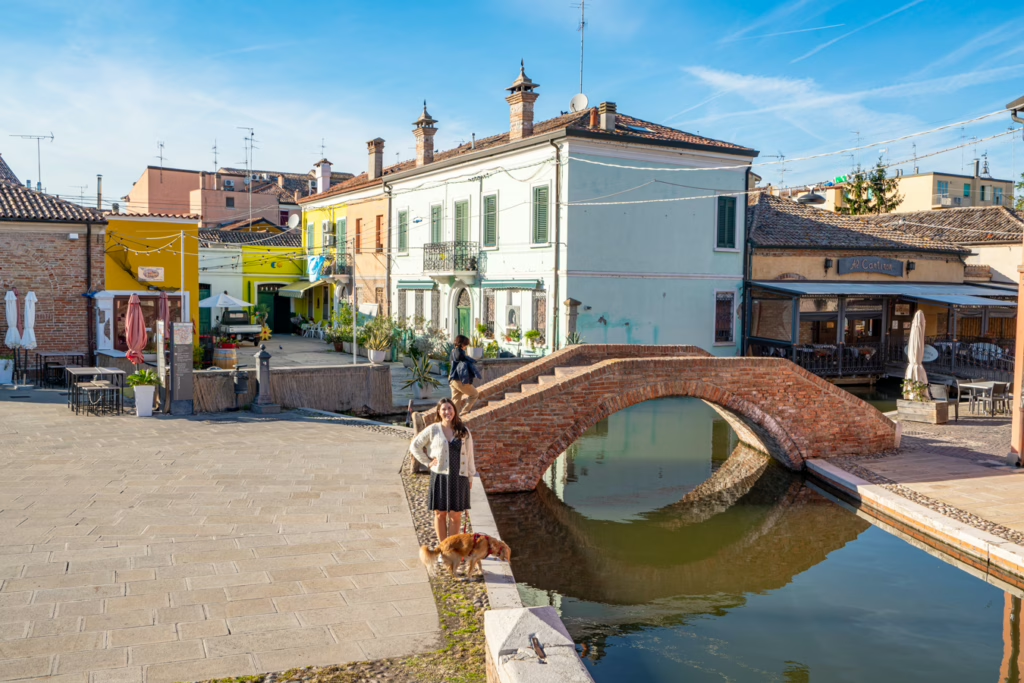
If you do opt to rent a car and drive like us, Ravenna makes an excellent base for visiting nearby destinations like Comacchio, Brisighella, San Marino, and more–not to mention all the nearby beaches!
Read More About Visiting Emilia-Romagna & Beyond
Excited to visit Emilia-Romagna soon, and maybe some other incredible Italy travel destinations too?
If you found this mosaics of Ravenna travel guide helpful, we’d love to continue to be part of your travel planning process here on Our Escape Clause!
You can browse our ~150 Italy blog posts here, read more about us here, or check out these guides to nearby destinations we love:
- 21 Best Things to Do in Parma, Italy (+ Tips for Visiting!)
- Secret Florence: 17 Hidden Gems + Off the Beaten Path Spots
- The Ultimate One Day in Bologna Itinerary
- 7+ Splendid Things to Do in Sirmione, The Pearl of Lake Garda
- How to Spend One Perfect Day in Venice (Itinerary + Travel Tips)
Map of the Mosaics in Ravenna, Italy
Take This Map With You! Click each highlight to pull up the name of the destination. To save this map to “Your Places” on Google Maps, click the star to the right of the title. You’ll then be able to find it under the Maps tab of your Google Maps account! To open the map in a new window, click the button on the top right of the map.
About Kate Storm
Kate is the founder and primary author of Our Escape Clause. Since 2016, she has been following her curiosity across the globe and turning her experiences into detailed trip planning advice for you. Her travels have taken her to 50+ countries, most regions of Italy, and most US states. After 4+ years of full-time travel, she enjoyed chapters calling Lisbon, New York City, and Texas home before deciding to base herself in North Carolina (between trips). She lives with her husband and business partner, Jeremy, their son, and their fluffy sidekick, Ranger.